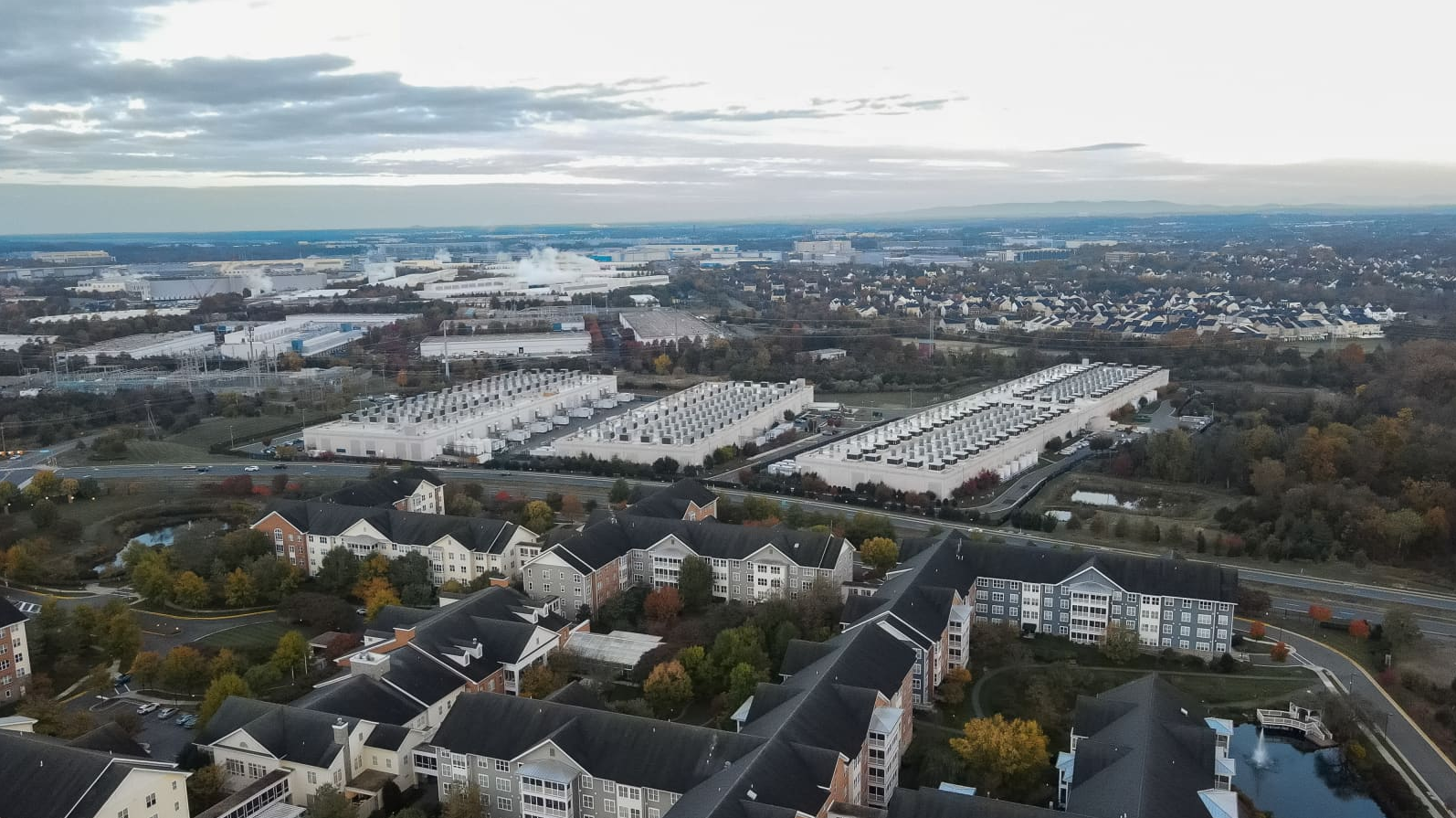

The global AI data center boom is creating unprecedented challenges for insurers and investors as private capital floods the sector, testing risk management frameworks and financial structures. Analysts warn that the scale, complexity, and rapid pace of developments in the sector are effectively creating a “stress test” for the insurance and finance industries.
Global spending on data centers is projected to reach $7 trillion by 2030, driven by demand for artificial intelligence, cloud computing, and advanced computing capabilities. While hyperscalers like Microsoft, Google, and Amazon traditionally led investment, private equity, private credit, and structured debt have become increasingly critical to financing these capital-intensive builds. Private infrastructure deals exceeded $10 billion last year, with the largest deal reaching $40 billion for Aligned Data Centers—a consortium including Nvidia, Microsoft, BlackRock, and Elon Musk’s xAI.
“When you put $10 to $20 billion plus in a single location, it creates capacity issues in the marketplace,” said Tom Harper, data center leader at insurance broker Gallagher. “The appetite is there because these are high-quality builds, but insuring such high-value locations has been extremely challenging.”
Insurance Challenges
Data centers combine massive real estate values with cutting-edge technology, requiring bespoke insurance policies that cover both physical and technological assets. Gallagher and other major insurers are designing specialized policies to account for the concentration of value, power generation requirements, and high-end hardware.
Will we see more data center deals breaking the $10 billion mark?
Global private infrastructure data center deals by value
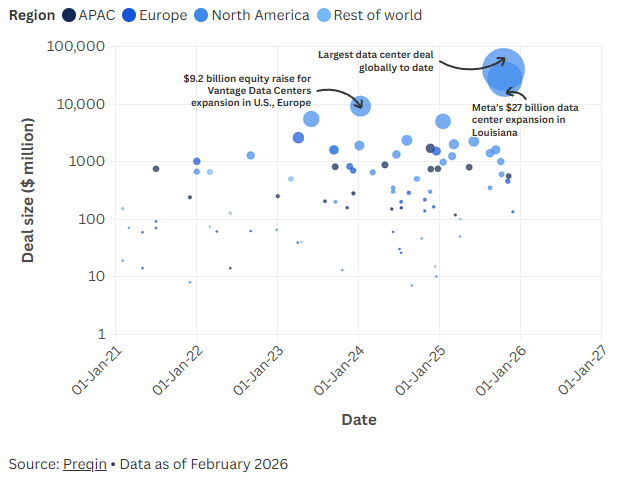
Concentration risk is a key concern: a $20 billion campus in a hurricane or high-wind zone presents enormous challenges for insurers. Supply chain disruptions further complicate coverage, as high-value equipment may be imported and stored temporarily in facilities not owned or operated by the data center operator.
Some insurers have responded by creating dedicated data center insurance avenues, while professional services firms such as Marsh have launched advisory groups to support clients in navigating complex contractual and insurance arrangements. Marsh’s Nimbus facility, initially launched with a $1.2 billion coverage limit for European data center construction, was expanded within seven months to $2.7 billion, reflecting the soaring scale of investments.
Data center deals shift toward infrastructure funds
Proportion of data center deals by asset class
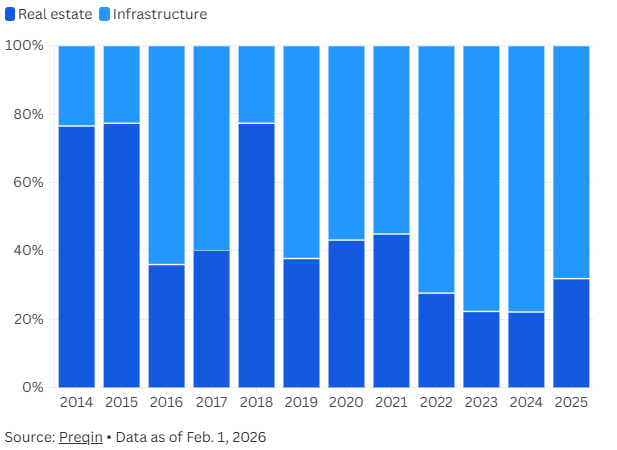
“Private credit can meaningfully complement banks and support non-hyperscale contracted offtakes,” said Alex Wolfson, senior vice president at Marsh Risk. “But as loans increase, insurers protecting lenders are reaching capacity limits.”
Financial Complexity and Risk
The rapid influx of private capital and off-balance-sheet financing has created transparency issues. Legal experts caution that investors, including pension funds and insurers, may not fully understand the concentration risks inherent in these deals, potentially exposing them to litigation. Rajat Rana of Quinn Emanuel notes that this mirrors the structured finance challenges seen during the 2008 financial crisis.
Digital infrastructure fundraising is highly concentrated
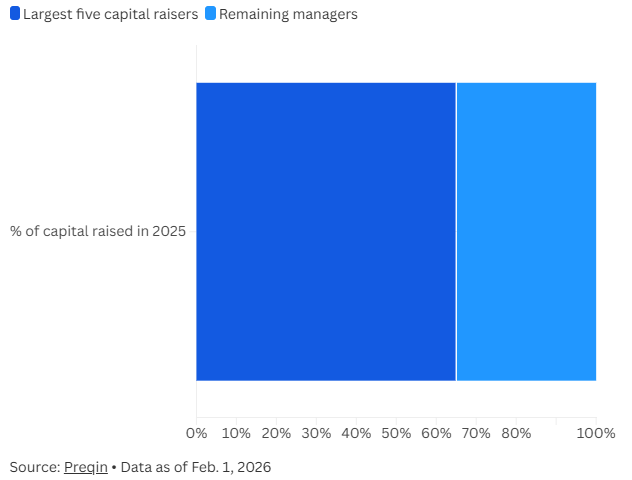
A particularly complex area is the “GPU debt treadmill,” where high-performance graphics processing units (GPUs) are used as collateral in loans. CoreWeave, a cloud AI company, recently secured $8.5 billion in a GPU-backed, investment-grade loan, illustrating both the scale and novelty of these financial instruments. GPUs have an average lifecycle of seven years, whereas data centers are designed to operate for decades, creating potential refinancing pressures and ongoing capital needs.
“Even if financing is ring-fenced and secured, the real risk is whether debt structures today can remain sustainable over the long lifecycle of the facility,” Rana said.
Tech and Operational Implications
The AI boom is driving rapid advancements in power generation, chip design, and data center infrastructure. Modular designs and interchangeable GPUs allow operators to manage shorter technology lifecycles while maintaining long-term facility viability. Insurers have had to adapt, creating predetermined asset valuation frameworks for bespoke policies to cover depreciating and high-turnover hardware like GPUs.
Meanwhile, private equity and private credit structures have fueled a surge in mergers and acquisitions in the sector, with specialized legal teams, real estate experts, and insurance specialists working on increasingly complex transactions. Companies are negotiating commercial leases, property valuations, and technology transfers in ways that were unheard of in traditional data center investments.
Broader Market Implications
Analysts suggest that the AI data center boom could have ripple effects across the global financial and insurance markets. With trillions of dollars invested off-balance-sheet, any mispricing of risk or failure to accurately assess asset concentration could trigger destabilizing losses. U.S. senators have already called for government oversight, warning of potential systemic risks if opaque debt markets continue to expand unchecked.
Despite these challenges, experts stress that the sector presents significant opportunities. Harper notes that AI data centers are highly desirable assets with cutting-edge technology, and the combination of high-quality builds and risk-spreading mechanisms make them attractive to insurers and investors.
“Whether the sector faces a crash or not, disputes are inevitable,” Rana said. “We’re already seeing disagreements over valuations, leases, and financing structures.”
In summary, the AI data center surge represents one of the largest peacetime investment projects in history, transforming insurance, finance, and infrastructure investment. While risks are significant, innovative financing, modular construction, and bespoke insurance solutions are allowing the industry to manage the scale and complexity of this historic boom.