

Washington — The crew of Artemis II is preparing for the most intense and critical phase of their historic journey — reentry into Earth’s atmosphere — which will include a temporary but crucial loss of communication with mission control.
After completing a landmark lunar flyby, the 10-day mission is set to conclude with a high-speed descent back to Earth, ending in a planned splashdown off the coast of San Diego. However, during reentry, communication between the spacecraft and ground control will be lost for approximately six minutes, a phenomenon known as a “blackout period.”
Why Communication Is Lost
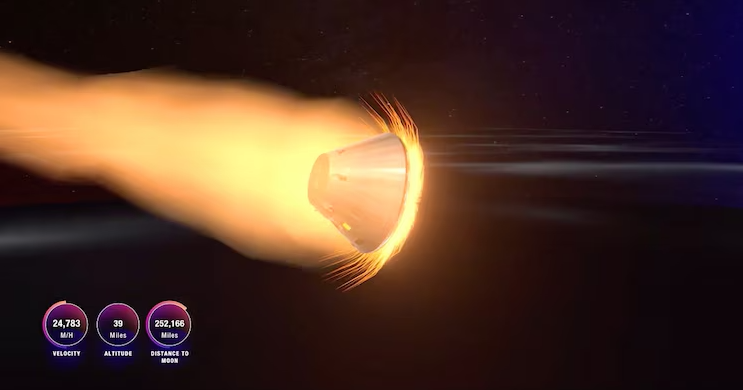
Unlike earlier communication disruptions — such as when the spacecraft passed behind the Moon — this blackout is caused by the extreme conditions encountered during reentry. As the Orion spacecraft enters Earth’s atmosphere at speeds exceeding 24,000 miles per hour, intense friction and compression generate temperatures of up to 5,000 degrees Fahrenheit.
This extreme heat forms a plasma layer — an electrically charged gas — around the spacecraft. The plasma effectively blocks radio signals, preventing any communication between the crew and mission control during this period.
A Critical Phase of the Mission
The blackout, though brief, is one of the most crucial parts of the mission. During this time, Orion relies entirely on its onboard systems and crew to safely navigate the descent.
Retired NASA astronaut Barry “Butch” Wilmore explained that astronauts are extensively trained for this moment. “You know the blackout’s coming,” he said, emphasizing that the crew must remain focused and continue monitoring all systems without external guidance.
Inside the spacecraft, astronauts will be closely observing instruments and ensuring all systems function correctly, as there is little room for error during this high-risk phase.
Heat Shield Takes Center Stage
As communication cuts off, Orion’s heat shield becomes the spacecraft’s most vital component. Positioned on the underside, it protects the crew from the intense heat generated during reentry.
The spacecraft’s maneuvering thrusters ensure that the heat shield remains correctly oriented toward Earth, absorbing and dissipating the extreme thermal energy.
Final Descent and Splashdown
Once Orion exits the plasma layer and communication is restored, the spacecraft will still be traveling at extremely high speeds. A sequence of parachutes will then deploy, gradually slowing it down to approximately 20 miles per hour for a safe splashdown in the Pacific Ocean.
The landing is scheduled for April 10, marking the successful completion of a mission that represents a major step forward in human space exploration.

A Test for Future Missions
The Artemis II mission serves as a critical test for NASA’s future deep-space exploration plans, including crewed missions to the Moon and eventually Mars. The successful handling of reentry — including the communication blackout — will be key in validating the safety and reliability of the Orion spacecraft for future astronauts.