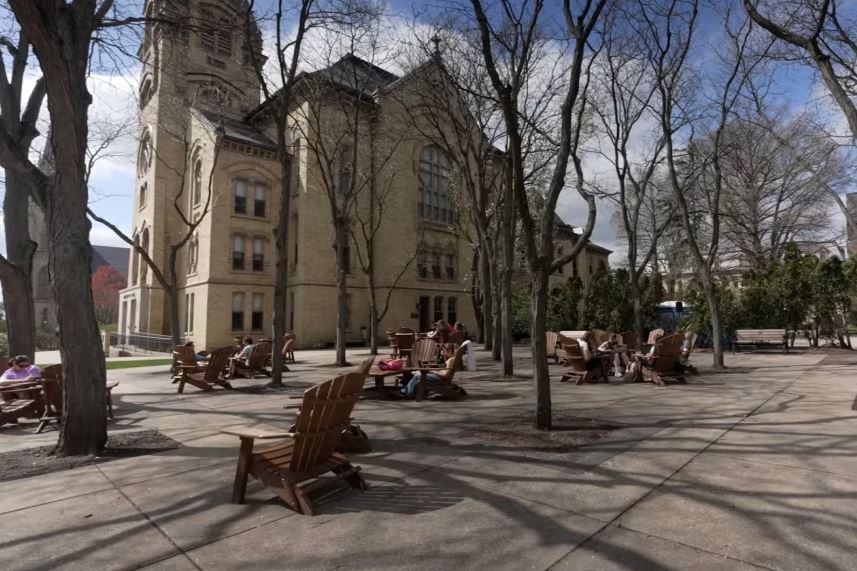

Students at the University of Notre Dame are expressing strong reactions following a growing public feud between former US President Donald Trump and Pope Leo XIV, with many describing the situation as shocking and deeply concerning.
The controversy intensified after Trump criticized the Pope over his stance on the ongoing Iran conflict, calling him “weak on crime” and “terrible for foreign policy.” The situation escalated further when Trump shared an AI-generated image appearing to depict himself as a Christ-like figure—sparking widespread backlash across political and religious communities.
At Notre Dame, one of the most prominent Catholic institutions in the United States, students from across the political spectrum voiced disapproval. Many described the imagery and rhetoric as disrespectful toward religious beliefs, with some labeling it “textbook blasphemy.”
The backlash is notable not only for its intensity but also for its source. Catholic voters have traditionally been a key and influential voting bloc in US elections, often swinging between political parties. Trump secured significant Catholic support in the 2024 election, making the current tensions particularly significant.
Prominent Catholic leaders have also weighed in. Paul S. Coakley, president of the US Conference of Catholic Bishops, expressed disappointment over the remarks, emphasizing that the Pope is a spiritual leader, not a political rival.
Meanwhile, Notre Dame’s president Robert A. Dowd issued a statement supporting the Pope’s message, highlighting its importance beyond political divisions and praising his call for peace.
The feud marks a continuation of tensions between Trump and Catholic leadership. His past disagreements with Pope Francis over immigration policies had already strained relations, but the current dispute appears more intense and politically sensitive.
Adding to the controversy, US Vice President JD Vance also publicly questioned the Pope’s stance on war, suggesting religious perspectives should be carefully applied in geopolitical conflicts.
Despite mounting criticism, Trump has stood by his remarks and declined to apologize, further fueling debate. Additional social media posts, including another religious-themed image, have continued to draw mixed reactions.
Analysts suggest that this ongoing conflict could have political consequences, particularly as Catholic voters play a decisive role in key battleground states. The situation underscores a broader clash between political authority and religious leadership, as well as the challenges of navigating faith in modern political discourse.
As reactions continue to unfold, the dispute highlights deepening divisions not only in politics but also within religious communities in the United States.