
Pakistan and Saudi Arabia have formally signed an agreement to extend a $3 billion deposit, providing much-needed support to Pakistan’s external financial position amid ongoing economic challenges.
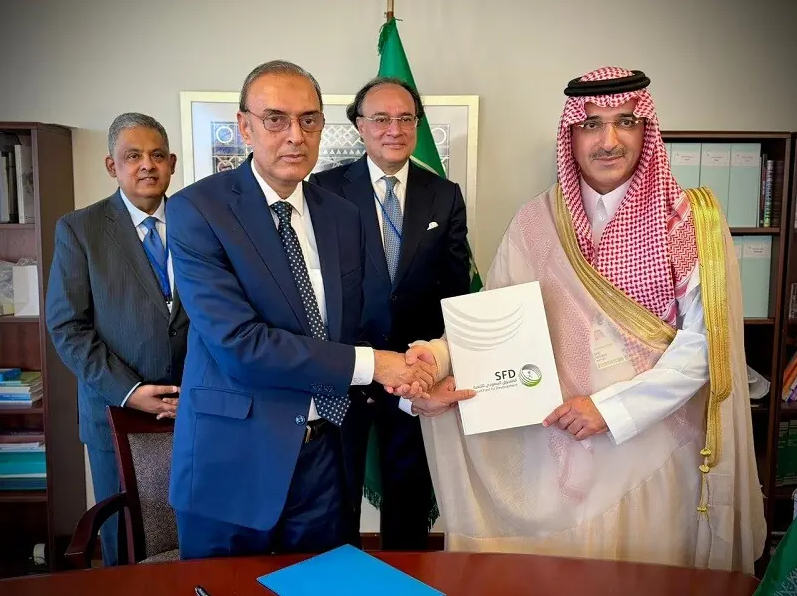
The agreement was signed between the Saudi Fund for Development (SFD) and the State Bank of Pakistan (SBP). Under the deal, the maturity period of the $3 billion deposit placed by SFD with Pakistan’s central bank has been extended.
The signing ceremony took place in Washington, DC, on the sidelines of the World Bank–IMF Spring Meetings, and was witnessed by Finance Minister Muhammad Aurangzeb, along with senior officials including Pakistan’s ambassador to the United States.
The agreement was formally signed by SBP Governor Jameel Ahmed and SFD Chief Executive Officer Sultan bin Abdulrahman Al-Marshad.
According to Pakistan’s Ministry of Finance, the extension reflects the strong and longstanding economic partnership between Islamabad and Riyadh, and is expected to support the country’s external account stability during a period of heightened financial pressure.
The development comes shortly after Saudi Arabia announced an additional $3 billion deposit and extended an existing $5 billion facility for three more years, signaling continued confidence in Pakistan’s economic management.
This financial support arrives at a crucial moment, as Pakistan prepares to repay a $3.5 billion loan to the UAE, which is expected to put pressure on foreign exchange reserves. As of late March, Pakistan’s reserves stood at approximately $16.4 billion, covering nearly three months of imports.
Economic analysts note that while Pakistan has made progress under its IMF-supported reform programme, external financing risks remain significant. Rising global oil prices and geopolitical tensions in the Middle East continue to strain the country’s balance of payments.
The Saudi assistance is therefore seen as a timely intervention to stabilize reserves, strengthen investor confidence, and help Pakistan navigate short-term financial obligations.