
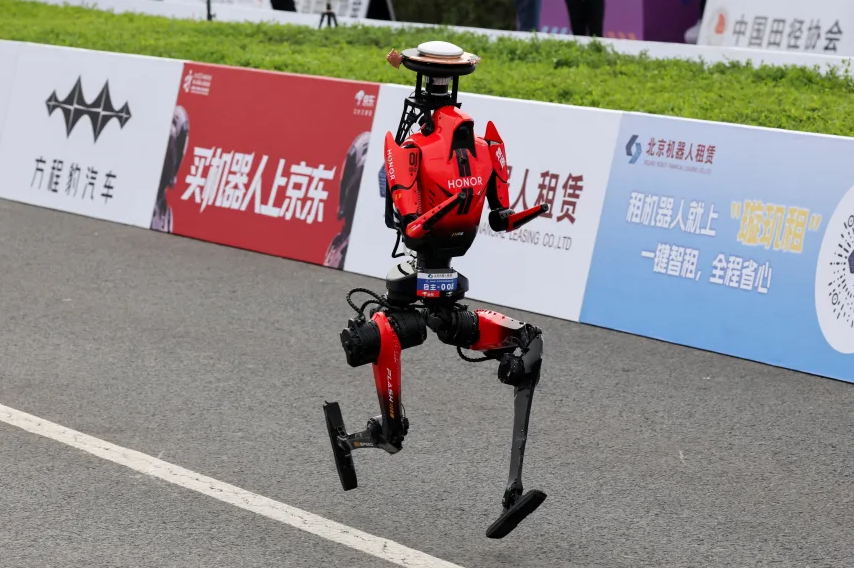

Beijing — A humanoid robot in China has stunned observers by completing a half-marathon faster than the world’s top human runners, marking a major milestone in robotics and artificial intelligence development.
The robot, named “Lightning” and developed by Chinese smartphone maker Honor, finished the 21-kilometer race in Beijing in 50 minutes and 26 seconds. This time beats the current human world record of 57 minutes and 20 seconds, set by Ugandan athlete Jacob Kiplimo, according to World Athletics.
Standing 169 cm tall, the bright-red android ran with short, swinging forearms for balance and maintained a steady pace throughout the race. Spectators and officials noted that it showed no visible signs of slowing down as it crossed the finish line.
The achievement highlights China’s rapid progress in humanoid robotics, an industry that has expanded significantly since 2015 when the government identified robotics as a key strategic sector for industrial modernization. A 2023 policy roadmap further elevated humanoid robots as a “frontier of technological competition,” targeting large-scale production and supply chain development by 2025.
In recent years, China has actively promoted robotics through public competitions and demonstrations. Beijing hosted the first Humanoid Robot Games last year, where machines competed in sports such as soccer, boxing, and martial arts. Robots have also appeared in televised cultural performances, showcasing coordinated movement and combat-style choreography.
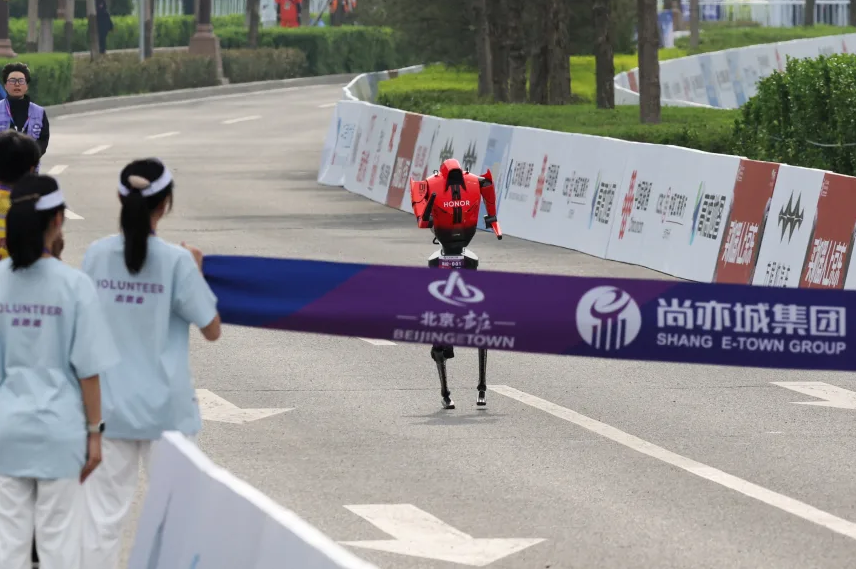
This year’s half-marathon featured more than 100 robotic teams, nearly five times the number from the previous edition. However, most entries struggled with endurance and speed, making Lightning’s performance stand out even further.
Human winners in the men’s and women’s categories finished the race in just over an hour, still well behind the robot’s timing. Organizers credited Lightning’s autonomous navigation system and burst-speed optimization for its record-breaking performance.
The event underscores growing competition between China and the United States in advanced robotics, particularly in humanoid systems designed for real-world physical tasks. While experts caution that such robots are still far from replacing human athletic capability in general conditions, the performance signals rapid progress in motion control, energy efficiency, and AI-driven navigation.