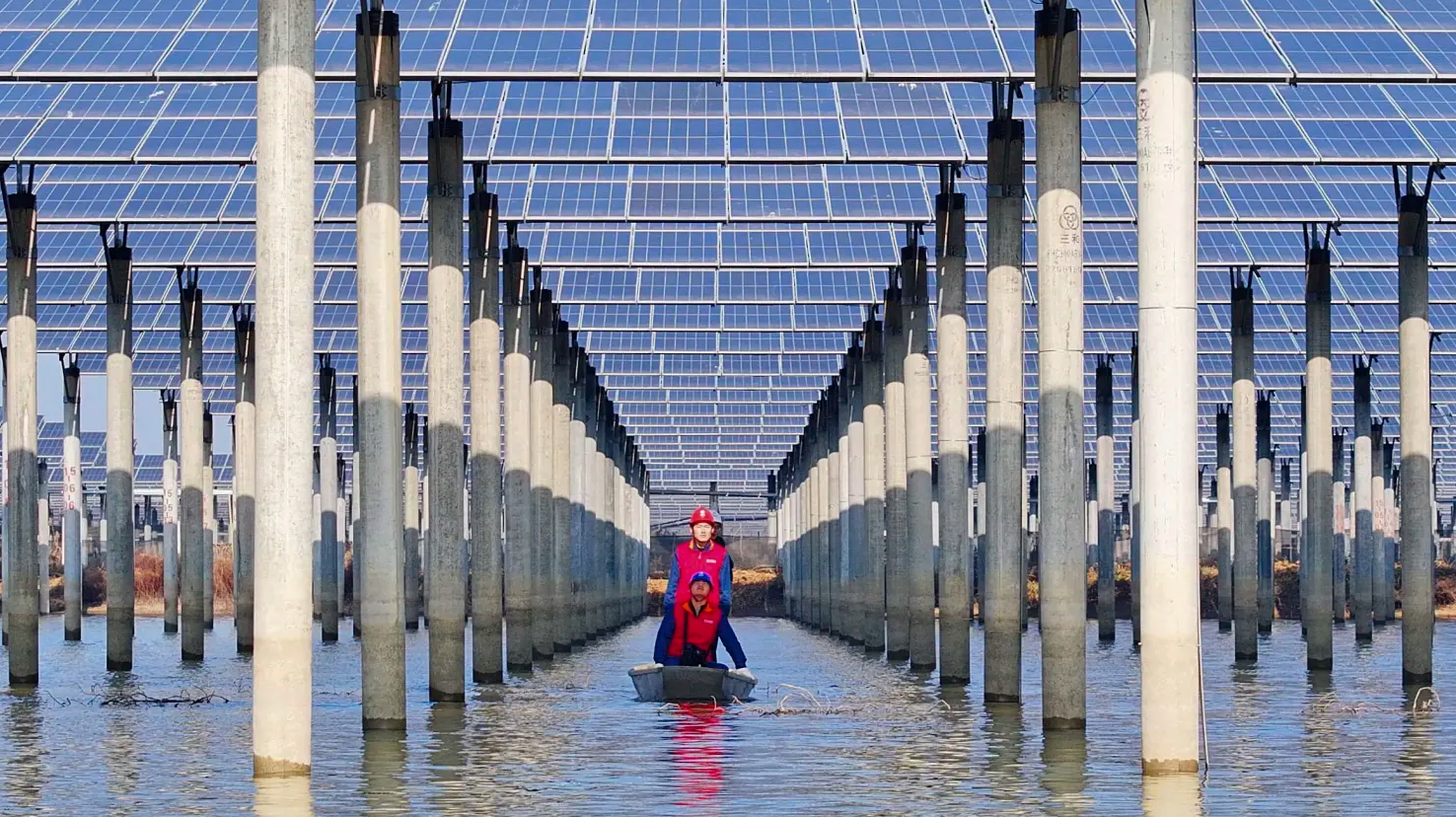

China has called for “concerted efforts” across government agencies and industry players to address a worsening overcapacity problem in its solar power manufacturing sector, as Beijing intensifies efforts to curb a prolonged price war and stabilize the industry.
The proposed policy direction includes capacity controls, stricter price enforcement, mergers and acquisitions, improved regulatory guidance, and stronger intellectual property protections. Authorities say the goal is to “promote the high-quality development of the photovoltaic industry” and reduce disorderly competition that has driven prices sharply lower in recent years.
China dominates global solar manufacturing, producing more than 80% of the world’s solar panel components, according to the International Energy Agency. However, rapid expansion by domestic producers has created a structural imbalance, where supply far exceeds global demand. This has triggered aggressive price competition inside China, a phenomenon officials refer to as “involution,” where companies undercut each other without improving overall industry value.
The issue has become a central concern for Beijing’s industrial policy planners. A recent high-level meeting involving the Ministry of Industry and Information Technology, the National Development and Reform Commission, major state-owned energy buyers such as China Huaneng Group and China Datang Corporation, and industry associations emphasized stronger inter-agency coordination to implement “anti-involution” measures.
The government’s latest push forms part of a broader campaign to restructure the sector and reduce inefficient production capacity. Authorities are increasingly encouraging consolidation through mergers and acquisitions, while also tightening oversight of pricing practices across the supply chain.
The overcapacity problem has also been intensified by weakening external demand conditions and geopolitical trade barriers. The United States has imposed tariffs on Chinese solar imports, while the European Union has been actively diversifying its renewable energy supply chains away from China, reducing reliance on Chinese manufacturers.
Despite global momentum toward clean energy, Chinese solar firms say the structural imbalance is unlikely to ease quickly. Even potential increases in renewable energy demand driven by global energy security concerns — including disruptions linked to geopolitical conflicts — are not expected to resolve the underlying oversupply issue.
Industry analysts note that while long-term demand for solar energy remains strong, the current market correction could be prolonged, as production capacity continues to exceed absorption rates across most international markets.
Beijing’s intervention signals a shift from unchecked expansion toward tighter industrial management, with policymakers aiming to stabilize prices, improve profitability, and reduce wasteful competition in one of China’s most strategically important green technology sectors.