

Oil prices drop and stock markets rise amid hopes of US-Iran deal
Global oil prices declined and stock markets rallied on Wednesday following reports that the United States and Iran are moving closer to a potential agreement to end the ongoing conflict.
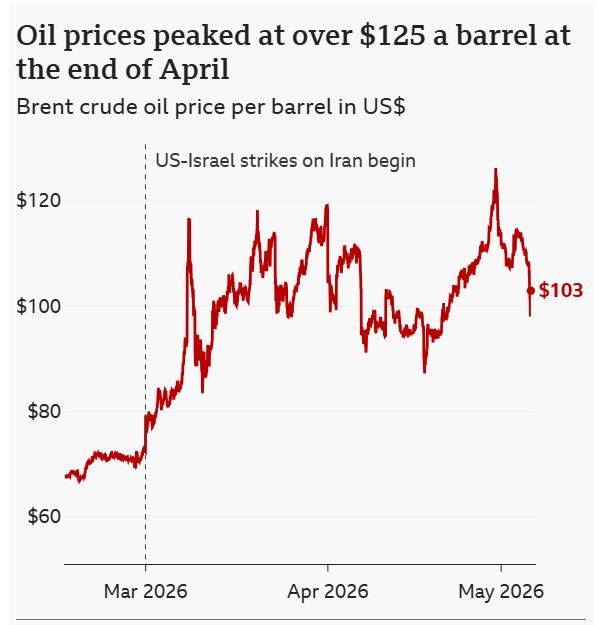
The price of Brent Crude fell sharply to around $97 per barrel before recovering to above $101. Earlier in the day, it had traded above $108, reflecting ongoing volatility in energy markets.
Investor optimism also boosted global equities. In Europe, the FTSE 100 and DAX both closed more than 2% higher, while the CAC 40 gained around 3%.
In the United States, the S&P 500 rose approximately 1% in early trading. Asian markets also posted gains, including South Korea’s KOSPI, Hong Kong’s Hang Seng Index, and Japan’s Nikkei 225.
The market reaction follows reports that Washington believes it is close to securing a preliminary agreement with Tehran. According to Axios, the proposed deal could take the form of a one-page memorandum aimed at ending hostilities and initiating broader negotiations.
However, uncertainty remains. Iranian officials have confirmed they are still reviewing the proposal, while US President Donald Trump cautioned that reaching an agreement is “a big assumption.”
Trump warned that failure to finalize a deal could lead to renewed military action at a significantly higher intensity than previous operations, including the recently concluded Operation Epic Fury.
Despite the recent decline, oil prices remain elevated compared to pre-conflict levels of around $70 per barrel. The ongoing tensions have disrupted production and transportation, particularly around the strategically vital Strait of Hormuz.
The narrow waterway, through which roughly 20% of global oil and gas shipments pass, has been effectively closed for weeks due to escalating military activity. Iran has threatened to target oil tankers in response to US and allied strikes, contributing to volatility in global energy markets.
Earlier developments had also influenced market sentiment. A ceasefire agreement announced on 8 April led to a temporary drop in oil prices and a surge in stock markets. However, tensions resurfaced after the US launched a maritime security initiative, known as Project Freedom, aimed at protecting shipping routes in the region.
The operation was later paused by Trump to allow space for diplomatic negotiations, further fueling speculation that a breakthrough could be near.
Reports indicate that the proposed agreement would mark an end to active conflict and initiate a 30-day negotiation period to address key issues, including reopening the Strait of Hormuz, limiting Iran’s nuclear programme, and easing US sanctions.
While the latest developments suggest progress, analysts caution that significant challenges remain, and a final agreement is not yet guaranteed.