

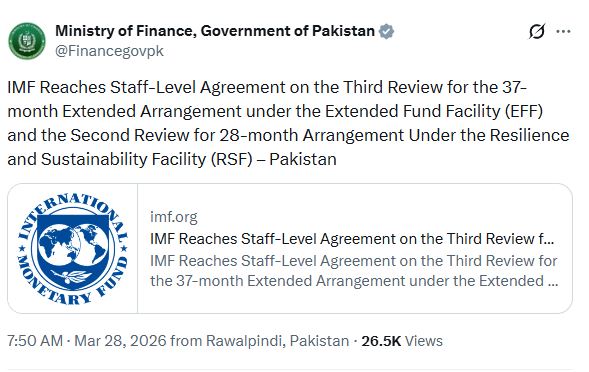
ISLAMABAD: The International Monetary Fund (IMF) has reached a staff-level agreement with Pakistan on the third review of its Extended Fund Facility (EFF) and the second review of the Resilience and Sustainability Facility (RSF), potentially unlocking a disbursement of approximately $1.2 billion.
According to an IMF statement issued on Friday, the agreement covers the third review of the 37-month Extended Fund Facility and the second review of the 28-month Resilience and Sustainability Facility. The agreement remains subject to approval by the IMF Executive Board.
Upon approval, Pakistan will gain access to around $1.0 billion under the EFF and approximately $210 million under the RSF, bringing total disbursements under the two programmes to about $4.5 billion.
Economic Progress and Emerging Risks
The IMF noted that Pakistan’s economic conditions have shown signs of improvement under the reform programme.
“Supported by the EFF, ongoing policies have continued to strengthen the economy and rebuild market confidence,” the Fund said, adding that economic activity has picked up while inflation and the current account have remained relatively contained.
External buffers have also strengthened, although the IMF cautioned that escalating tensions in the Middle East pose risks, including volatile energy prices, tighter global financial conditions, higher inflation, and potential pressure on growth and external balances.
Fiscal Targets and Policy Direction
As part of the review process, Pakistani authorities and IMF staff finalised key outlines of the upcoming 2026–27 federal budget, including a proposed tax collection target of Rs15.08 trillion for the Federal Board of Revenue (FBR).
The IMF has also encouraged Pakistan to adjust petroleum product prices more frequently to better reflect global market trends. The country has already shifted from fortnightly to weekly price revisions, with further adjustments under consideration.
Policy priorities outlined by the Fund include maintaining fiscal discipline, broadening the tax base, improving expenditure management, and enhancing spending on health, education, and social protection, alongside better coordination between federal and provincial governments.
Monetary and Exchange Rate Policy
The IMF emphasised the need for the State Bank of Pakistan to maintain a tight, data-driven monetary policy stance and remain prepared to raise interest rates if inflationary pressures intensify.
It also reiterated that exchange rate flexibility should serve as the primary mechanism to absorb external shocks, particularly those arising from global geopolitical developments.
Energy Sector and Structural Reforms
On the energy front, the IMF stressed the importance of maintaining sustainability through timely tariff adjustments to ensure cost recovery and avoid untargeted subsidies.
It highlighted ongoing structural reforms, including efforts to reduce circular debt, improve power transmission and distribution, privatise inefficient generation companies, and transition toward a competitive electricity market and renewable energy sources.
Social Protection and Reform Agenda
The Fund also acknowledged the government’s commitment to strengthening the Benazir Income Support Programme (BISP), including inflation-indexed cash transfers, expanded coverage, and improved payment systems to protect vulnerable households.
Broader reform priorities include state-owned enterprise restructuring, privatisation, anti-corruption measures, and climate resilience initiatives under the RSF framework.
The agreement marks a key milestone in Pakistan’s ongoing economic reform programme, reinforcing investor confidence while underscoring the need for continued policy discipline amid global economic uncertainty.