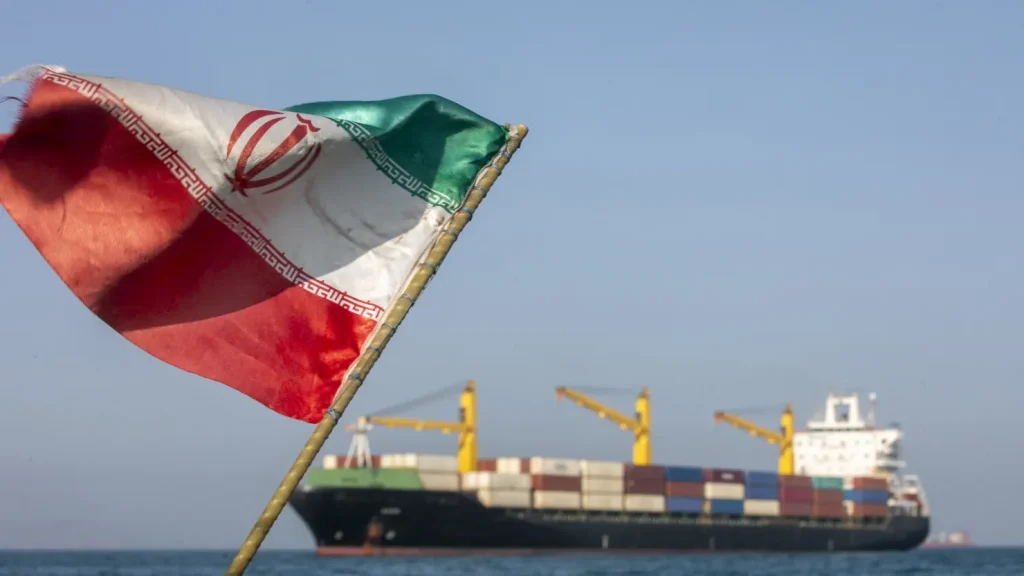
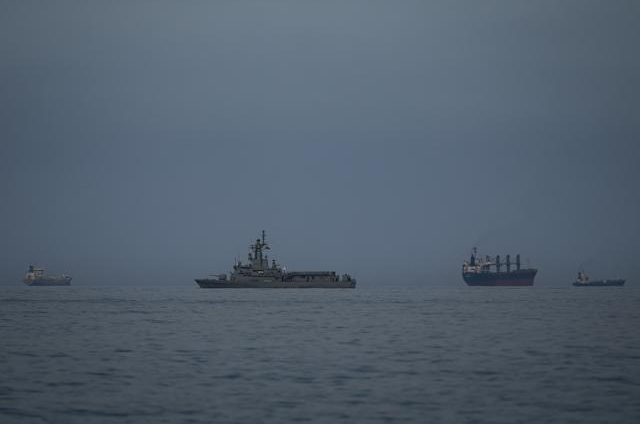

US President Donald Trump has announced that the Strait of Hormuz is now “completely open and ready for business,” signaling a temporary easing of tensions in one of the world’s most critical النفط transit routes.
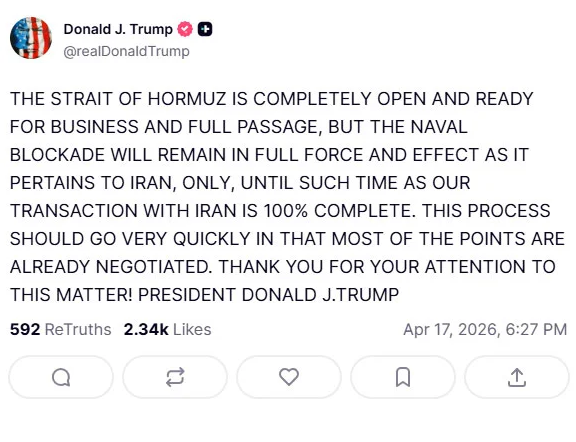
The statement came via Trump’s Truth Social platform, offering reassurance to global markets after weeks of uncertainty caused by conflict in the region.
⚓ Blockade Still Targets Iran
Despite reopening the vital shipping corridor, Trump made it clear that US military pressure on Iran remains firmly in place.
He stated that the naval blockade will continue, but will specifically target Iran until negotiations between the two sides are fully concluded.
“Most of the points are already negotiated,” Trump said, suggesting that a broader agreement with Tehran could be reached soon.
This dual approach — reopening trade routes while maintaining strategic pressure — reflects Washington’s attempt to balance economic stability with geopolitical leverage.
🛢️ Global Implications


The Strait of Hormuz is a vital artery for global energy supplies, with a significant portion of the world’s oil shipments passing through it daily.
Any disruption in the strait has immediate consequences for:
- Global oil prices
- Energy security
- International shipping routes
The reopening is expected to ease immediate fears of supply disruptions, though continued military presence and restrictions on Iran may keep markets volatile.
⚠️ Fragile Stability
While the announcement signals progress, analysts caution that the situation remains fragile.
The continuation of the naval blockade underscores ongoing tensions between Washington and Tehran, even as diplomatic efforts appear to be advancing.
The coming days will be crucial in determining whether this temporary stability evolves into a broader agreement — or if the region slips back into uncertainty.